
Hello!
Back in September 2025, I gained a fascination on Erebor, a proposed new digital asset bank that was seeking a federal charter. So this post is a dedication in talking about it.
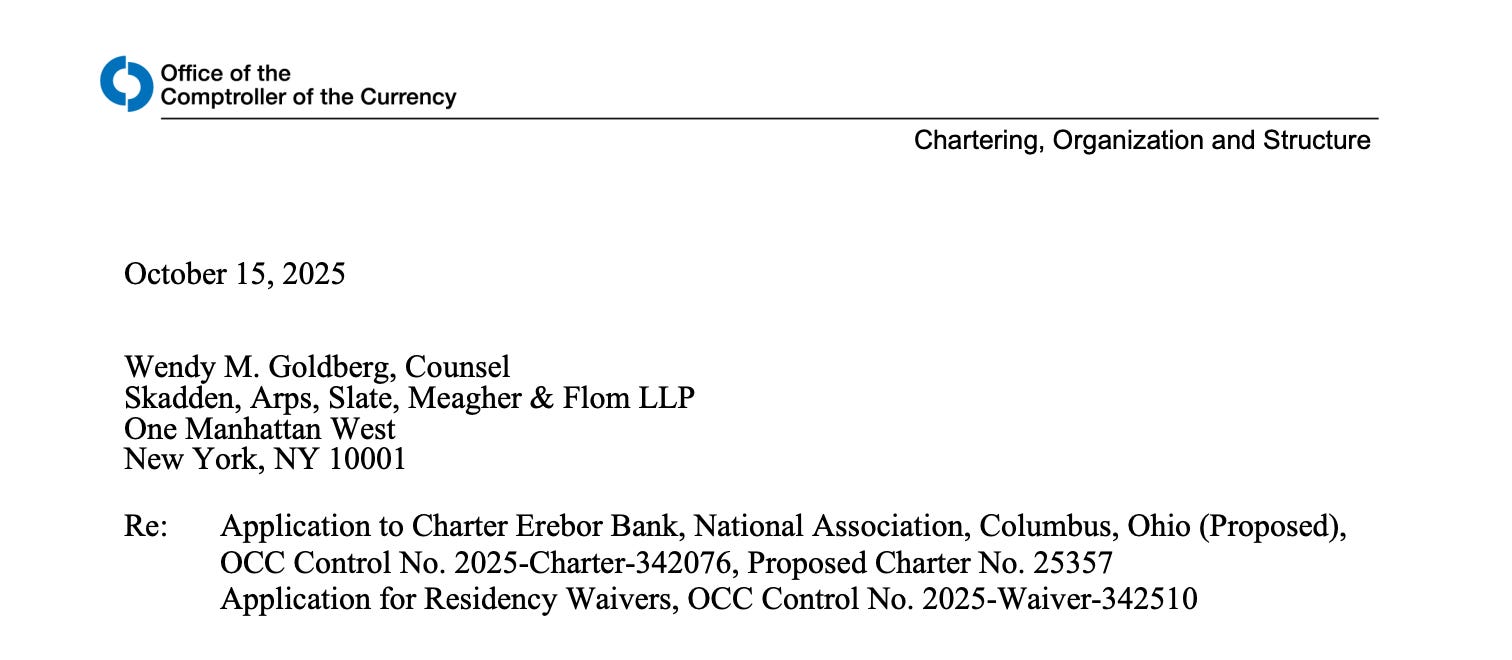
I read the submission of a new de novo bank filing + related literature so you don’t have to, and now I’m going to hold you hostage with it.
Enjoy!
I said enjoy!
p.s. Bitgo just got one of these on 12/12

Quickly now, what are you talking about?
What is Erebor, and why is it important?
Erebor Bank is a newly proposed U.S. national bank backed by Silicon-Valley-adjacent investors like Peter Thiel and that Anduril guy, and it just received conditional approval in October 2025 to be chartered as a bank. It aims to combine traditional banking services with crypto/digital-asset banking for tech, crypto, AI, defense, and manufacturing firms.
Here’s why this is big:
We haven’t had a new bank chartered since 2008. Between 2000 and 2008, over 1,000 banks were chartered per the IF12697 Congress Publication. After 2008 to 2023, only 90 banks were chartered (As mentioned by Acting Chairman Travis Hill of the FDIC) - this represents such a significant drop in banking innovation which would be stormed by both fintech and cryptocurrency products.
And here’s what I’m going to focus on:
What is it, and is it good for retail consumers, and is it good for companies? The answer is, let’s find out, yes, then no.
Where did the name “Erebor” come from?
Are you new here?
For those of you joining in this newsletter, hello. I shall do my best to set definitional terms for you: We are going to refer to institutions as banks, established financial service players, and well anything that isn’t a start-up at this point,.

Erebor, the First Digital Asset Bank
TL;DR:
Totally not a bank for my very rich friends energy
Yes for consumers and great for any stablecoin ecosystem narrative
Mid (subpar) for actual company operations
What is it?
It is a de novo national bank (thats fancy for “Newly Form” which rarely happens these days) headquartered in Ohio and it will focus on traditional banking + emerging technology and digital asset sectors. It’s investors are all the tech billionaires, basically.
It achieved conditional approval late 2025 (Office of the Comptroller of the Currency), which means we can expect a soft launch 2026. Given it’s ties to the administration, it wasn’t unexpected but it was surprising that it received conditional approval in less than 4 months since it filed its June 2025 application when the acceptable average is around 12 to 18 months
The formation of this bank is significant for the following reasons:
Tech billionaires and their companies, who amass their fortunes through yet-to-be regulated spaces as well as hyper-growth companies, are underserved especially on the digital asset front.
The U.S. hasn’t been approving de-novo banks all that often, especially a bank that is intentionally exposing itself from day zero to crypto.
2022 saw the peak hostility against any form of digital assets from the US Federal Administration and Banks, so to see something “fast yes” 3 years later is representative of the incredible tone shift
All digital asset ultra high net worth ($30m+ in investable assets) are going to be so stoke that 1) they could possibly bank with Erebor, and 2) they can take loans against their positions as extended as 150% LTV. That means they can get loan at 150% their value - i.e. I can get a $1,500,000 loan using $1,000,000 of Bitcoin, ideally spread across 3 years.

Is it good for retail consumers?
Yes for the retail consumers and great for the stablecoin ecosystem narrative.
But to appreciate why it’s good, it’s mostly because there aren’t many banks that will bank a crypto company, without the crypto company hiding itself behind elaborative dull explanations of itself. If you as an individual try to go to a brick & mortar bank, it will most likely end in a weird, or hostile, experience.
Erebor is a net great advancement in the institutional narrative adoption of cryptocurrency (stablecoins) and any chain that has a proven stablecoin offering is going to benefit from Erebor’s 2026 launch. So, Solana, Sui, Base, Avalanche, Ethereum and so forth.
This all translates to: Finally a bank that doesn’t despise me.
In pursuing the digital asset space, Erebor enters a very resented market, and this will make them the temporary heroes of the era.
I can also expect Erebor to have a sort of tiering on digital assets (as been suggested in the wave of crypto legislation in 2025). That tiering basically is a determination on whether a token is security, or a commodity, and the classification will set of a mental model of “closer to standing with Bitcoin and thus Tier 1” than you are an “alt coin or some non-consequential coin”.
From an institutional standpoint, that’s a great advantage to be recognized as Tier 1 because it means:
The risk associated with that blockchain ecosystem is lower than others
The blockchain ecosystem has a strong maturity compared to others
Institutional liquidity in the form of traditional loans and debt offerings are more readily available
As a consumer, it means I can take a loan against my digital assets just like any other asset without having to actually liquidate it into cash. Digital Asset-backed loans via trad-fi are open for discussion!
Context: As of 2022, Fannie Mae & Freddie Mac only allow cryptocurrency if it has been exchanged into U.S. Dollars, which effectively means, “sell your crypto” - I can’t wait to…not do that.

The Mid Part
That said, I was able to have access to specific readings around the business model and the offering of Erebor, I can’t help but conclude that the target customer for Erebor isn’t blockchain foundations or developer companies, it’s ultra high net-worth individuals who ultimately want to be able to take out trad-fi loans against their digital assets, as well as get a simple bank for their unbanked company. The bar is quite low for this capital demographic.
Expectedly, Erebor will have a huge reliance on IntraFi, which is FDIC $250k insurance but multiplied across all the commercial banks in the network so it’s like $100m,
plus their credit underwriting framework (see commentary on Tier 1 in previous section),
and their filing application forces a highly liquid and conservative balance sheet and a need to be ultra conservative which means not having concentrated deposit risks tied to one company or a group of companies
These suggest that the initial banking business model is tailored for ultra high net worth consumers ($30m in Digital Assets) and smaller companies, but it wouldn’t really service all too well Crypto Foundations whose treasuries are in an untold amount of crypto capital.
I also don’t think it’s going to be remarkable for companies, besides the fact that they get a bank.
At best it’ll be a “better than nothing” offering which is a let down for companies whose treasuries depend on digital assets and financial technology improvements.
It would, however, be the first major institutional legitimacy.
The following portions are from something I think I read.
Erebor’s Target Customer
I think, besides anything with a digital asset pulse.
Ultra High Net-worth Individuals that Erebor can confidently consider a 150% Loan-to-value credit line on the individual’s assets. POV a 40% LTV is conservative, 20% is ultra, 60% is the default, 100% is what you see in Defi, and 150% or above is only for very high net-worth individuals. You’d only offer that if you have that “deep relationship” which suggests to me the same level of deal diplomacy Trump gives, but to the Erebor owners. Only a few of the customers would be this; the rest of us will get like the 20% treatment.
They also have a single-depositor risk capped to 10%, and top-10 depositors are capped to an aggregate of 35%. Basically, it can’t have such a deposit concentration such that one person accounts for 10% of Erebor’s banked assets. This signals to me that it can’t really bank full on Foundation Treasuries, and at this state, Erebor would prefer small & many deposits from from High Net-worth Individuals instead.
Hilarious Advantages
Regulatory: Incredibly close to the current US Administration, all the way to VP Level. It’s most likely going to have an easier time getting regulatory approval.
Since this was written in September 2025, as of October 2025, Erebor has conditional approval to be chartered.
Niche: Erebor could have a high density of every single US crypto client, and may already have a line up of all customers (aka the unbanked digital asset billionaires) before it launches. That means it has a distribution advantage off the bat.
Asset Seizures: Erebor’s business model is dependent on credit operations and loans - so much so that they expect to give out loans that are 70% asset backed. Terms can be between 90 days to 3 years, $100k minimum, with different threshold applied to various tiered assets. That means in the event of a continued market down turn (i.e. more than 3 months), Erebor could liquidate a lot of positions and seize collateral from individuals. And then, because it’s a bank that’s bankrolled by billionaires, it will out-survive the crash and sell the seized assets at much higher gains.
If you’re a token, here’s what you need to argue for: To be recognized as a good Digtal Asset by Erebor and the broader Institutional Market, which is a function of a great many deal of other hurdles cleared. Otherwise the end consumer ability to make loans against their assets drops off a cliff based on their proposed LTV. If you are not Tier 1 asset, your ability to get a trad-fi loan backed in your digital asset diminishes.

Mid for actual company operations
That said, would I use this in Company operations? For Treasury opportunities, probably. For actual company operations where we have to handle payment -
Eh.
While it does make it a little easier, I would not consider it significantly easier. Here’s why:
For Company Operations:
It brings down the complexity of stablecoin transactions downward to a regular bank ACH/wire as Erebor would remove swap-operations. Swap-operations suck. Erebor instead would handle it like a non consequential foreign currency transaction, which is a huge plus.
It could allow a company to have one approval workflow policy for outbound stablecoin/wires, instead of two approval policies that have different requirements. Approvals for crypto are very different from approvals over a banking wire, and it’s a function of technological limitation or overt security, depending on the scenario.
Let’s assume stablecoin payment risk is downgraded to be like direct wires. Direct wires are still risky and burdensome for operations teams and doesn’t eliminate or “make this easier”. A company running direct wires is a company that is extremely inefficient (i.e. very early company days). To have company operations fully adopt Erebor, it not only needs to handle the swaps, it also needs to handle approval workflows & scheduling payments for stablecoins, AND, connect into existing accounts payable processes & solutions so that the overall company energy involved to make a payment is minimal.
Let’s look at type of spend and implications.
Types of Spend:
Credit Card Spend
For decentralized organizations with high trust and smaller dollar amounts, it’s a lot easier for a company to pay for things using credit card. Erebor isn’t going to move a needle directly on this area, though it does have the opportunity to provide lines of credit (credit cards) to individuals/companies with sufficient digital assets on their balance sheet.
Unfortunately, this then becomes a question of “how great is Erebor at Credit Card Management / Spend Management”. There’s a reason why Brex, Ramp, and Amex Corporate Cards exist even with Chase Banking having it’s own business credit cards.For retail consumers, this is going to unlock major customer potential especially with those that have crypto but no credit history.
Accounts Payable Process
It’s incredibly inefficient for companies to solely rely on direct wires, and by extension, direct wallet to wallet crypto payments, to pay for things. Companies build Accounts Payable to create control, visibility, and extreme efficiency in paying vendors. That is, unless Erebor also builds the payment authorization API that connects into existing Accounts Payable Solutions such as Bill, Netsuite, and so forth, to the Erebor Bank Account.
In which case, it eliminates all concerns from “Direct Wires” and “Crypto Payments” Direct Wire. If it were possible for a FInance & Operations function to receive an invoice wherein the counterparty stipulates a USDC payment, and FinOps could execute it using existing Accounts Payable software to get approvals and schedule the payment in the future, based on a vendor account that is KYBed and they already gave their payment instructions, and I don’t have to think about the asset to back the payment, then this would be seamless and desirable. But that’s not what Erebor is entering the market as.Bottomline: A company’s accounts payable can easily handle invoice processing and accuracy, but there’s a lot of what would have to be true statements for that to be the case.
What Would Have to Be True:
Erebor handles swapping and it maintains competitive rates as well as processing speed
Erebor cash/stablecoin accounts can be interacted with via ACH-like pull or API pull from an Accounts Payable Software
The Accounts Payable software would handle multiple teams/peoples involvements async, the two or three way invoice match, gather internal approval, vendor records, and scheduled payments.

It’s a Net Good for the Stablecoin & Crypto Ecosystem Narratives
Gotta unlock digital asset wealth somehow.
Erebor’s existence will be a net good given how low this bar is. It opens the door for the next wave of company financial process innovation at institutional level, finally addressing an underserved market that at this point is very resentful.
It’s future is also guaranteed via a Paypal x Erebor relationship happens due to Peter Thiel’s involvement there too.
We shall see.
Never has there been a more exciting time in banking than now, can’t imagine what 2026 has in store here.