
Eve Frontier: The Opportunity for a Moddable MMORPG Propped by a Non-Player Developer Base
I'm not even going to hold your hand as I throw you into this world you didn't know about.
Originally written ~September 2025, around the Cycle 2/Cycle 3 phase of Eve Frontier. Eve Frontier is currently in Cycle 5.
Summary:
Eve Frontier is a massively online space-based video game that relies on scarcity, time, and player interaction to drive the gameplay loop.
It’s a space-based logistics simulator with scarcity, time sinks, and decay. Fundamentally, it’s going to be harder than Eve Online, the studios current flagship game.
Expected Initial Core gameplay: exploring, mining, slow resource movement, building the first supply chains, don’t get pirated.
The First Gamers: Early adopters will be solo base builders, industrialists, and optimizers, and of course those trying to PvP (player vs player combat).
There is no mature in-game economy yet. It’s not that the developers forgot to implement an economy, far from it actually - it’s that all the new players have not figured out how to stand up economies because no one knows what to do, so it will be just complete frenzy and mania.
Conflict (Corp v Corp, which is the PvP aspect) is mostly impractical because of the lack of economy and manufacturing in game- give it time and the player base will make that so they can wage constant war.
Blockchain (it’s Sui Protocol.) based Tooling and Applications will emerge organically, driven by necessity, grind reduction, and combatting “time”. This one reads simple - its actually the reason this game is going to create a new category of “gamers”.
Smart contracts offer automation and in-game power projection with minimal online presence, and more PvP when the time comes.
Just in case it didn’t sound office, Eve Online, and by extension Eve Frontier, is Geopolitics Simulator in space.
EVE Frontier: Phase 1
A First Look at the Infrastructure MMO
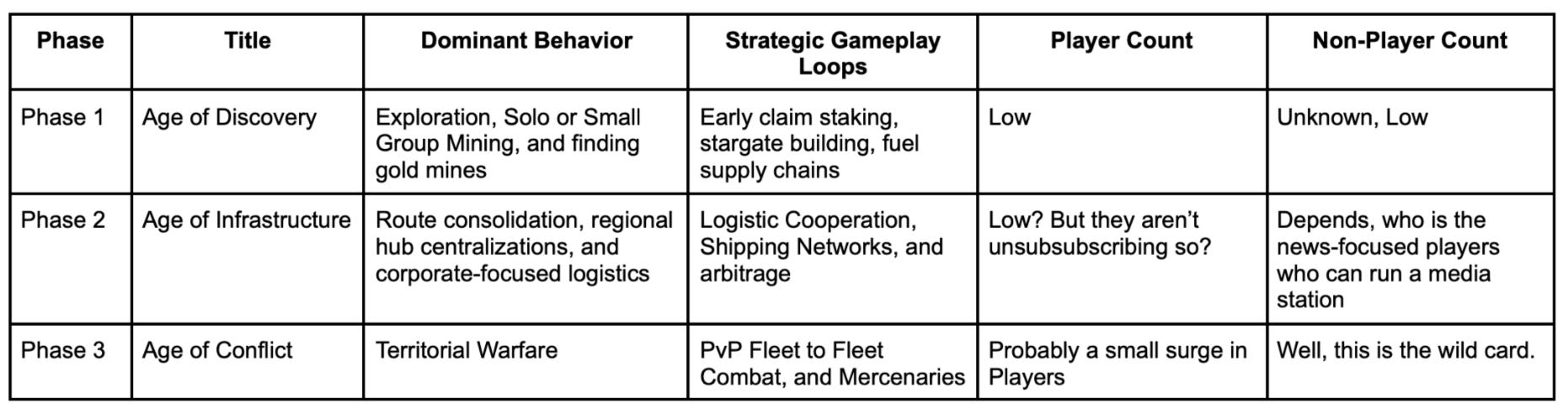
EVE Frontier is launching in what can best be described as a Phase 1, “Age of Discovery” state for the public.
It’s not about fast action or flashy gameplay. It doesn’t have those exciting, fast-paced core game loops yet. It’s a game about laying the first bricks of a functioning interstellar economy, where tenuous cooperation, time-sinking coordination, complex logistics, and smart contract competition define success more than gaming reflexes or starship kills.
It’s a Geopolitical Simulator in Space, but not of the Star Trek abundance mindset, but rather a hyper capitalistic scarcity mindset.
For context: EVE Online is a sandbox MMO that has operated for over two decades with entirely player-driven economic, political, and military systems. What makes EVE Frontier different is both its tabula-rasa narrative state and its native integration of blockchain primitives. The blank state and blockchain elements give players not just ships to fly, but tools to shape the game’s narrative, economic, and classical online coordination.
For existing EVE players, one of the greatest enemies in EVE Online is time itself. This translates to: Active energy. EVE Frontier’s introduction of smart contract based gameplay (player-made applications that can be accessed in-game or through a browser) is going to shift how much active energy is needed to do things, and how much they’ll benefit from automation running their backend.
But I’m getting ahead of myself. We’re a long way from there.
In this early phase of Eve Frontier, gaming will feel slow. Because it is slow. If you’ve read a Dune book, it is that slow. It will be tedious, and if you’re looking for conventional excitement, this ain’t it. You have good odds at binging a Netflix TV show while doing “in game work”.
For infrastructure-minded thinkers, people who like resource management games and systems building, this is the blank-slate moment. An opportunity to build systems, economies, and tooling that can endure for years.
Let’s call this Phase 1. Here’s how I see the arc:
What Phase 1 Will Actually Looks Like
It’s going to be a blank state. It’s going to have no infrastructure built by players to do things.
No infrastructure. There are no stargates yet, no Panama Canals, no Suez Canals. Travel is long and expensive in terms of fuel and time. I can’t even buy fuel at the start. To jump across 34 systems early in testing took me an hour, and I already knew how to play.
Tools are primitive or nonexistent. Every MMORPG spawns side tools — calculators, websites, wikis. I expect the same here. But I also wouldn’t expect CCP to build everything that makes the game easier. They have to balance inherent difficulty to the point where players innovate on their own. There’s a reason EVE Frontier has a literary notebook app built into the game.
The incentives aren’t where you expect. Until the end of Phase 1 or into Phase 2, the in-game player economy is too underdeveloped to sustain PvP warfare at meaningful scale. The real incentive for all players is survival — making it to the point where people can reliably buy from other players to shortcut manufacturing and fleet production.
The core users in Phase 1 are explorers and base builders. This is No Man’s Sky territory. The next wave are opportunists hoping future players will use what they built.
In practice, players will be:
Surveying unknown star systems for resources. Travel is time-consuming. There’s a real risk of getting stranded in a star system because you poorly planned your route and couldn’t find compatible fuel. You’ll need someone with a vending machine extorting you for money. That person might be me.
Constructing mining and refining facilities across star systems they can quickly reach.
Establishing shipping lanes between resource-rich and manufacturing-heavy areas. The greatest achievement in Phase 1 may be the stargates being built and maintained. You’ll see players build them for free, then toll-roads emerge, then pillaging. Or a stargate that just ran out of energy and stopped working.
Building up resources for when an expansion drops. Not an arms race yet, those features haven’t released, but everyone is slowly piecing together the economic backbone that enables future players to wage expensive conflict.
This makes EVE Frontier a logistics simulator with an extremely high skill ceiling. Completely dependent on player-side infrastructure.
What Matters for Industrialist Players and Developers in Phase 1
EVE Frontier is incentivizing technical (sorry AI-enabled!) power-users, industrialists, to shape the meta (core game play loops to “win”) of Phase 1, which will completely decide how Phase 2 and Phase 3 unfold.
And to allow players to shape the meta, CCP Games is leaning into the concept of a Moddable MMORPG.
Here’s a live-service game, in one server instance, and we’re allowing you, the gamer and/or developer, to alter a lot of how you’re going to “win”. Modding is typically not supported or actively frowned upon in online-only games. EVE Frontier goes the other direction and commits to the idea, as its predecessor Eve Online has.
It starts with a core ruleset (controlled by CCP Games), then layers in a permissible, and encouraged, vector of development from the player community: Their own way to tackle the resource allocation, and subsequent power projections, in the game, via blockchain technology. [Editor’s note: As of Oct 2025, CCP Games has adopted Sui Protocol, of which as of March 2026, Sui has been integrated and they are in the player testing & build phase.]
Core Ruleset (Or what CCP game is launching the game with)
Scarcity. In-game resources are scarce, which makes the production curve for ships, guns, and stargates harder to sustain. To put it differently, as of the time of this publication, the world is pinched again by oil strains. You get the same in Eve Frontier.
Time. Everything in EVE Frontier is slow. Activating a turret. Building a capital ship, can take days. Flying, which you’ll measure in meters per second and hopefully kilometers per second, can take a while if an object is 100km to 500km away.
Atrophy. Nothing is permanent. Everything can be blown to pieces — by players or by roaming NPC pirates, or by the inherent quality of what you made.
Put all three together, and you’ve attracted the same consumers who play Dwarf Fortress, Rimworld, Factorio, Stardew Valley, and Satisfactory. But also like Korean-Style MMORPG Grinds.
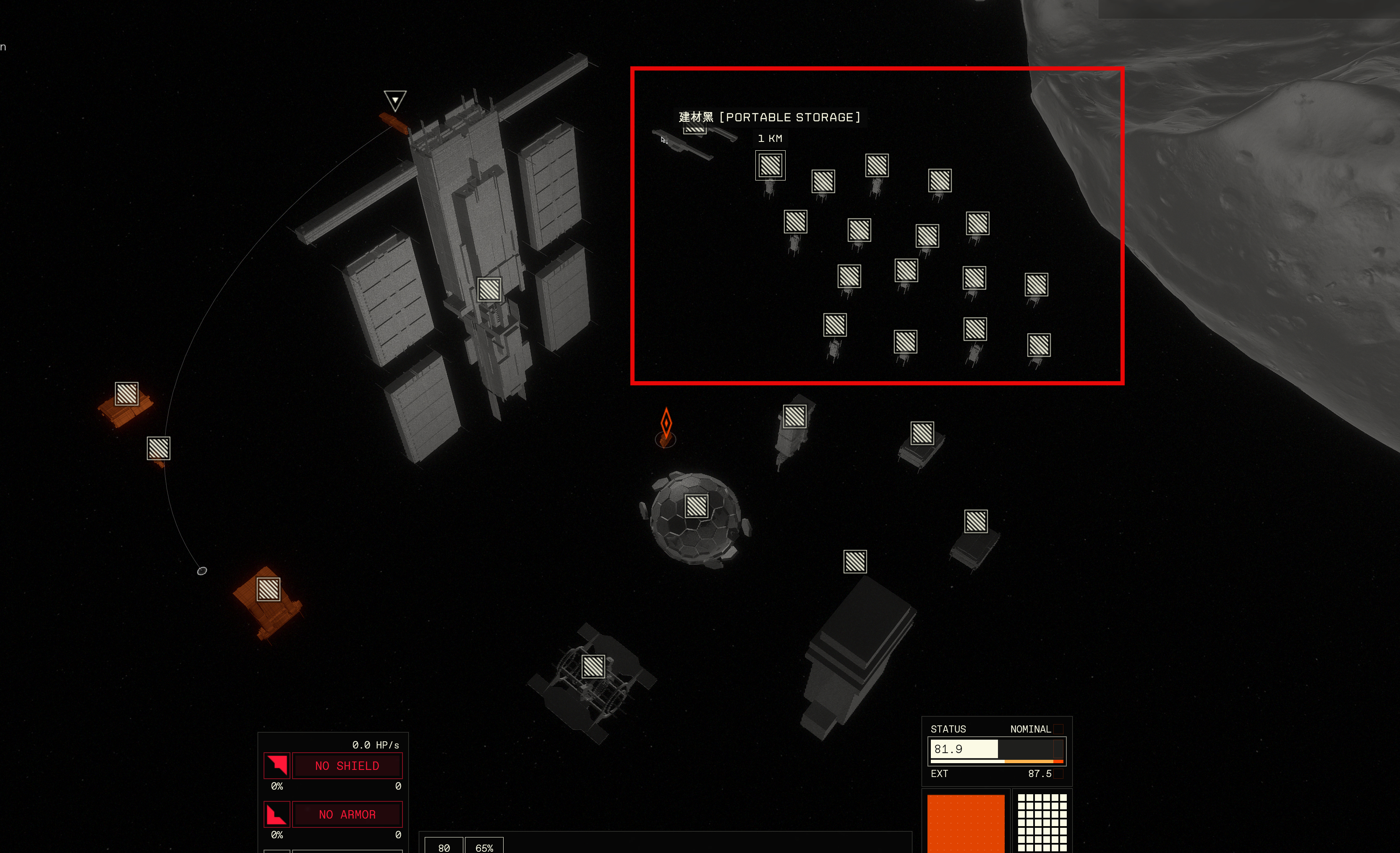
Smart Contracts:
There’s something beautiful about not only allowing but incentivizing the ecosystem to mod the game via dApps. I fully expect CCP to take a hands-off role in what a dApp can do.
For ease of understanding, dApp, or decentralized Apps, can be as simple as a smart-contract that does X, and it can interface with something in the game. It’s decently crazy to think “hey gamer, make a tool (vibe code it), publish it (it gets hosted on the blockchain at no cost to the user), and deploy/tie it in the game (it’s performance is based on the user and if it does as it’s supposed to do).
MMORPGs already get supplemented by wikis and gameplay planners so players can min-max them. But rarely has there been a direct, incentivized connection from those online tools to in-game interaction.
And rarely has there been an opportunity for non-gamers to directly impact the game itself, through sheer software development, and concurrently earn value for providing development services to those playing EVE Frontier directly. You don’t even need to know how to write a smart contract. Sometimes simple wikis and websites are just fine.
A New Surface Area for an MMORPG
This unlocks an entirely new type of interaction because you don’t need to play the game to advance the game’s narrative. Here’s what I expect to see emerge:
Smart contract-based logistics corporations.
The terrible blessing and curse of an MMORPG is that it’s a persistent, always-on universe, and time is annoying. Smart contracts help shift “active hours” to other areas of opportunity.
Under Phase 1, I’d expect simple automations. A space vending machine that dispenses fuel in exchange for crypto, positioned in a terrible part of space where you’re stranded with a haul you’ve promised to deliver. Bonus points if there’s a pirate gang roaming nearby but conveniently leaving the vending machine alone. I’ll even sell you ammo for your travels. When inventory runs low, the contract automatically posts a courier job to resupply, dynamic pricing based on regional player count or inventory level. If couriers keep stealing the goods, require a bond. All of this was done in EVE Frontier.
By Phase 2, corporations will need to build something equivalent to Amazon Prime’s fulfillment center, coordinating mining, manufacturing, warehousing, and shipping, with player-to-player guarantees if anything goes wrong. I wouldn’t be surprised if by Phase 2, a niche corporation emerges that delivers X units of Z class starship to your system while you wage war. Just-in-time logistics in space.
Treasury tooling.
At Phase 1, treasury tooling will be nonexistent. Everyone will have their own proprietary spreadsheet. The first generation of corporations will have no taxes, just gangs of players going around until invasions become permanent and a gang needs to join a bigger corporation. Then war comes, resources need replenishing, and suddenly taxes and tithes are required.
Getting taxed in a corporation is a weird concept. But in EVE, the tax pays for the “fighter” type players to replace their ships without using personal funds, and those PvP players protect the industrialist. I can’t wait until bounties get set on specific players and the corporation that claims them gets its automatic payout via escrow.
By Phase 2, I expect Ponzi schemes to begin. EVE Online had player-banks. It worked until it didn’t. Look up the 2009 E-Bank incident if you’re interested. It is always an incentive in these games. And that’s part of it.
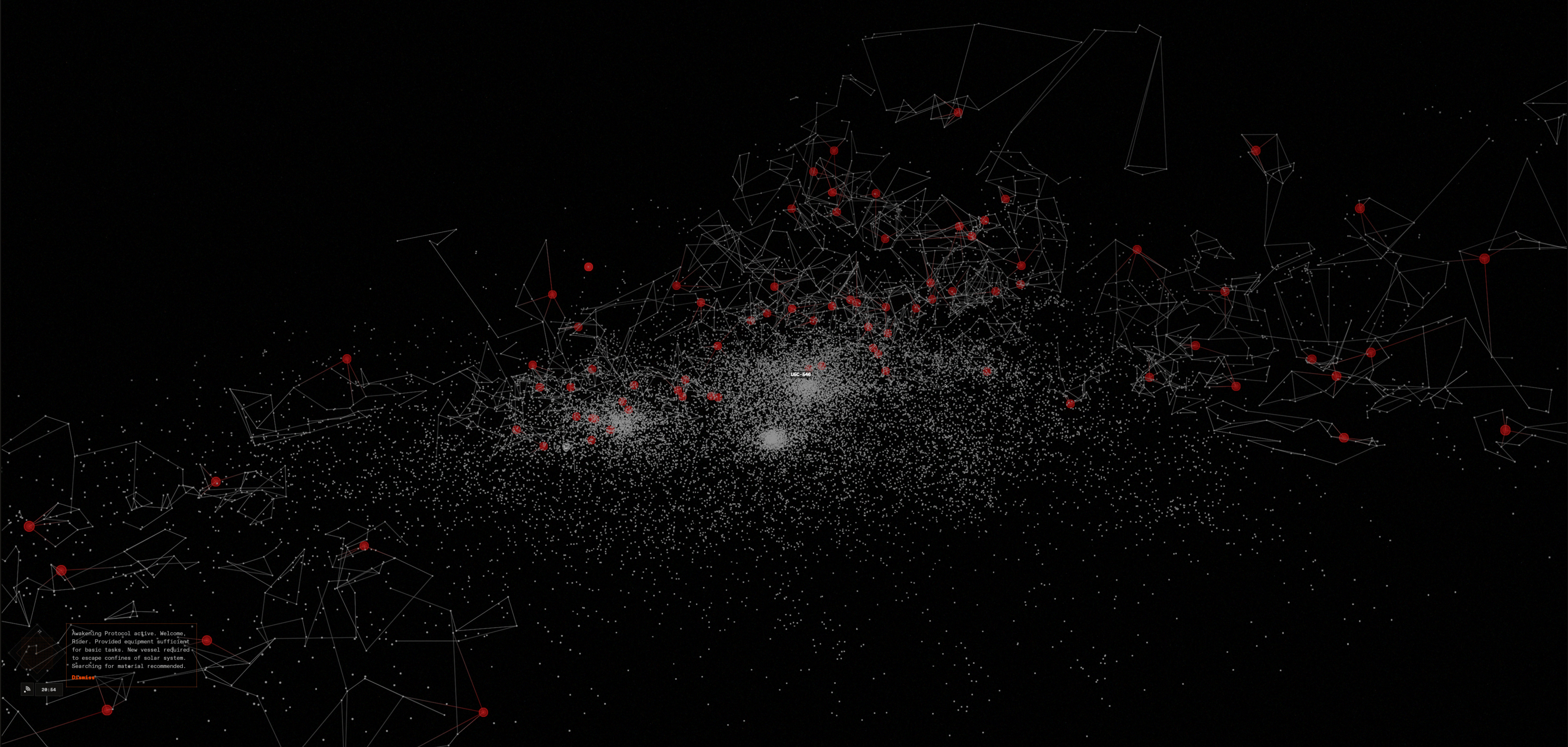
Token-based alert systems.
Space fleet combat is about 0.01% action and 99.99% getting lost and hoping not to get detected. Stargates that run dApps can register who — by wallet ID — is using them. That information can be sold, or stolen, to determine traffic data or whether warships are approaching. Which reminds me: it is completely legal in EVE Online to disassemble ships, put them into freighters, ship them into deep space, then reassemble battleships at the other end — without anyone noticing the Trojan horse sitting at their doorstep.
Data scrapers and dashboards.
For all the min-maxers and industrialists. People will scrape data. In Phase 1, it starts as item stats and production rate data — that already exists as a player-made wiki. It will advance to: “What systems does X good sell well in, and at what unit and price?”
EVE Frontier likely won’t have any game-developer-designated commerce space. It’s up to players to figure out where trade will happen, based on physical in-game distance and accessibility. Someone convincing players on the other side of the universe to make the long trek to their market — because the promise of stable security and fair prices is too good — will need something communicating that rich data set 24/7. It won’t be a person doing it manually.
Custom routing and fuel optimization.
Route planning like a Tesla telling you where the Superchargers are — that already exists via third-party tools. I do expect truck stops to emerge. Vending machines everywhere. Stargates to key points. Advertising on in-game bulletin boards convincing players passing through to go somewhere. Player-run Nigerian Princes. EVE Online has its own in-game email system. EVE Frontier does too. You see where this is going.
Competitive Advantage Comes From Tooling
Most MMOs constrain innovation to what the game engine allows. EVE Frontier goes further: competitive innovation, inside a gaming ecosystem.
There’s a direct incentive to:
Build better internal ops tools for your player-run organization
Create dApps and services others subscribe to, reducing active hours spent on boring tasks
Hoard resources, accumulate EVE Token or LUX
Leak or steal tooling to gain a strategic edge
Exploit misconfigured smart contracts in rival networks
I expect a technical arms race. And if EVE Online taught me anything, the winners won’t be the best pilots. They’ll be the best industrialists. It’s hard to compete against a corporation that can deploy ships faster than you can shoot them down.
In Phase 2 and 3, Payroll, Taxes, Escrow, and Insurance become dominant. But I don’t expect those in Phase 1. The phase of the game dictates what tools are needed.
The tradeoff: low player count at the start. By design. EVE Frontier has enough non-sexy problems to discourage many players — and concurrently, to attract exactly the right ones.
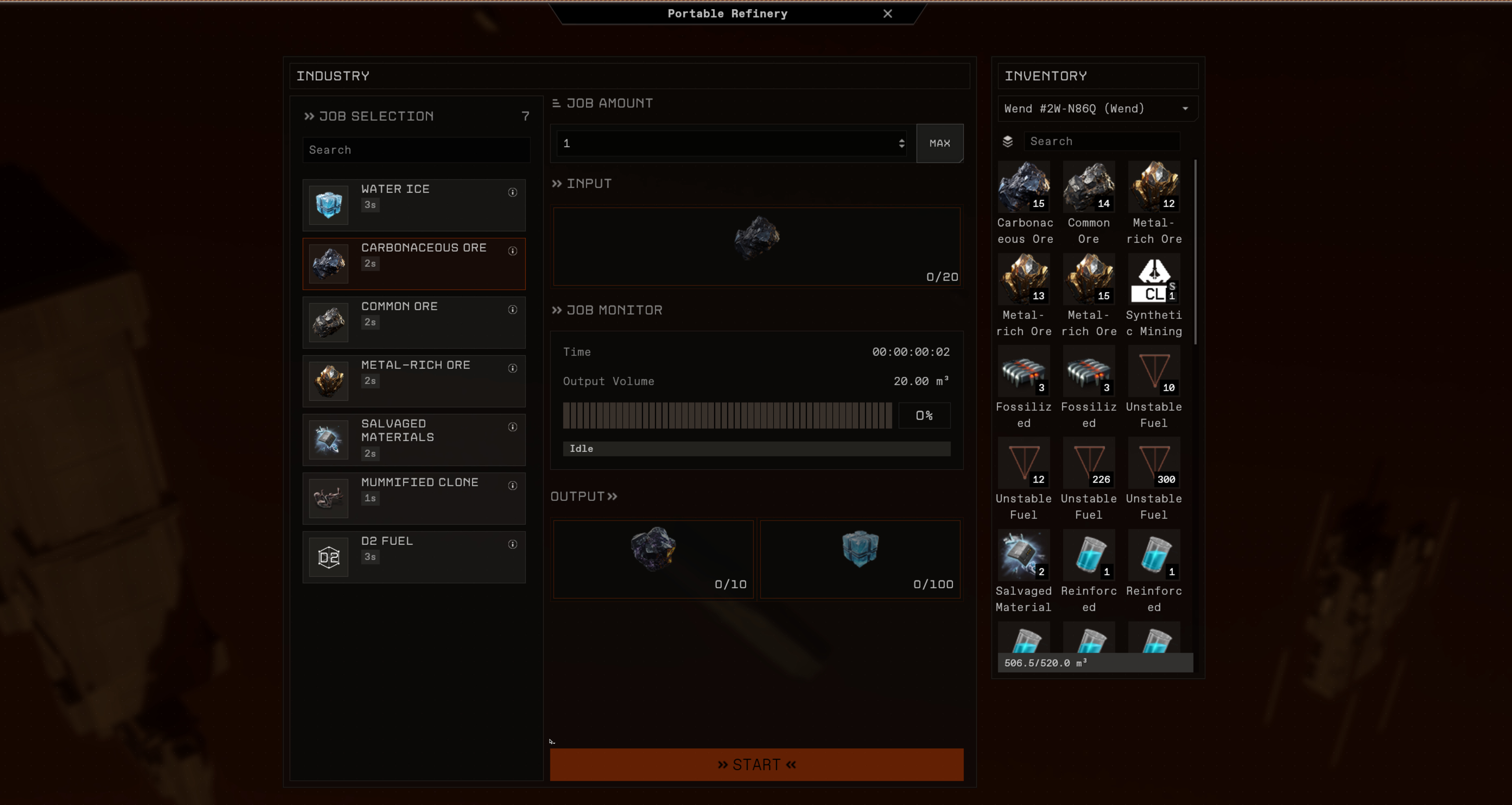
Player 3 Has Joined the Game, But Not Really
Traditionally, gameplay splits between PvP (player vs. player) and PvE (player vs. environment).
EVE Frontier adds a third vertical:
Those who play for PvP: fighters, pirates
Those who play for PvE: miners, haulers, builders
Those who don’t play at all, and instead develop tooling or analyze in-game data for the ecosystem
And because there’s crypto involved:
Opportunist. In-game, we call them scammers and grifters.
Non-playing developer roles that will likely emerge: Logistics Platform Engineers building cross-system shipping dashboards. Data Analysts scraping on-chain data and player location logs. Smart Contract Auditors scanning public corp contracts for vulnerable logic. Governance Devs designing resource pooling structures knowing that war, espionage, and attrition are facts of this universe.
A Platform for a New Meta of Open Source Gaming
In traditional MMOs, the game studio controls the technology ceiling. Ships, weapons, defense systems … all finite, all balanced by the developer.
In EVE Frontier, the most powerful competitive advantage may come from what non-gamers solve for gamers that the studio doesn’t touch directly. Expect: players paying outside devs to write logistics software, tooling dashboards, and coordination apps. And eventually: compromised scripts, dApps with backdoors inserted into treasury tooling, false dashboards designed to bait opposing fleets into bad routes.
This is the natural trajectory of an open economic protocol layered on top of a sandbox MMO.
Maybe by Phase 3, software built on EVE Token currency will earn more than CCP Games itself. Now that would be something.
Putting This Into Perspective
One of the largest battles in EVE Online happened in 2014. Estimated $300,000 in ships destroyed. 7,500 participants across 717 corporations and 55 alliances. The direct conflict took 21 hours.
The buildup took years.
Over 5,000 capital ships were involved.
215 Titans — the largest capital ships in EVE — were fielded.
75 Titans were destroyed.
Titans were introduced in December 2005. The first player-built Titan appeared in September 2006, nine months later.
Building one requires 24/7 construction and defense — an entire alliance of players, minimally 50 online at all times, plus 100+ territory defenders. Titans can be destroyed mid-construction.
They weren’t even effective at launch. They were bait. You spent another year or two enhancing them before they could do anything. Back then: no automations, no industry behind them. Built entirely in secret.
Today, it takes about 6 weeks to build a Titan.
The Slow, Passive Excitement
EVE Frontier will be a slow build. It has to be — in a game where time is the currency.
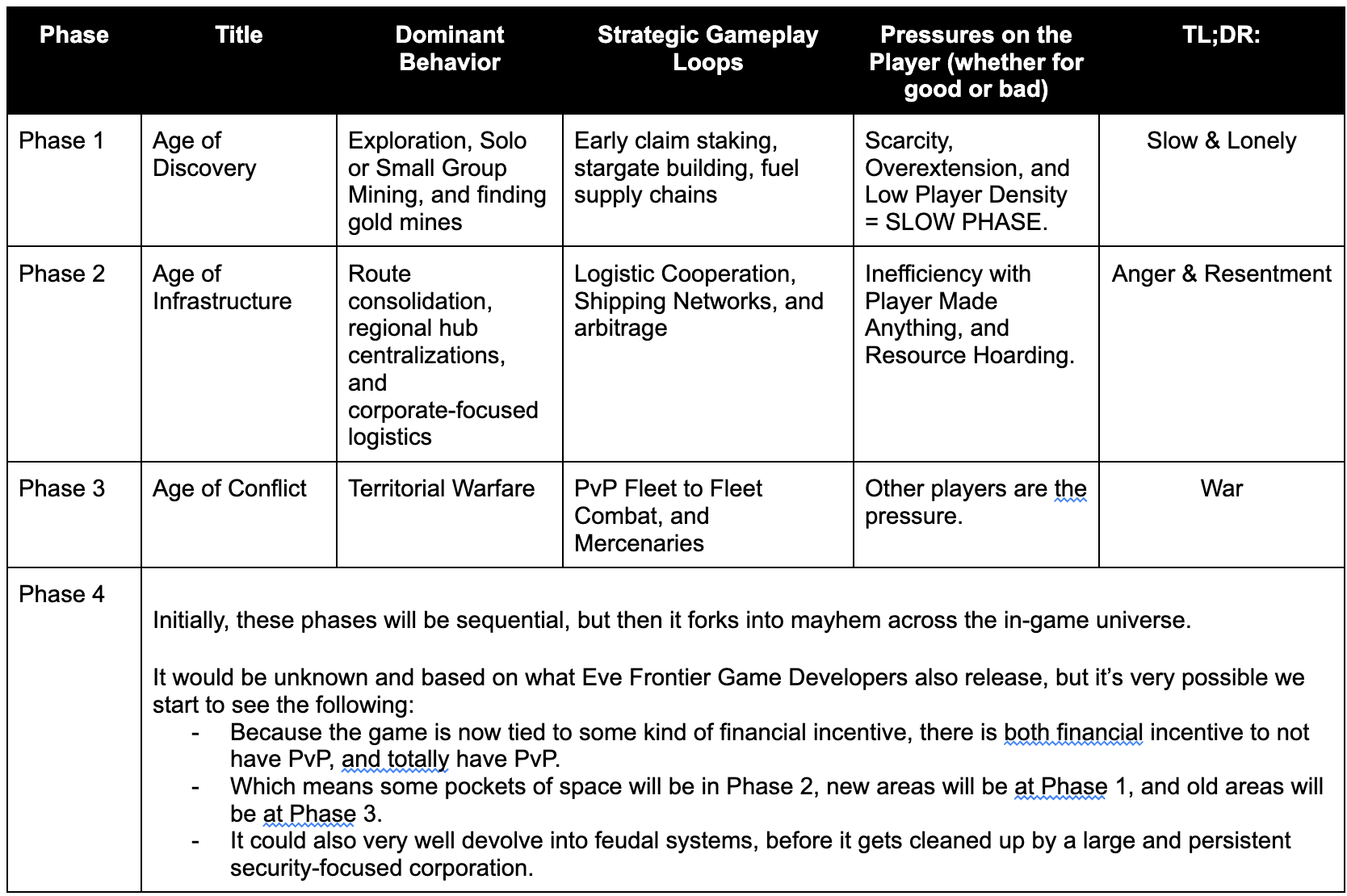
These phases will be sequential at first. Then they’ll fork across the universe simultaneously — some pockets at Phase 2, new areas at Phase 1, old areas at Phase 3. It could devolve into feudal systems before a large security-focused corporation cleans it up.
And all of it will eventually be met by CCP’s actual EVE Frontier expansions: new ship classes, new weapon tiers, new regions of space, new non-player enemy threats.
Happy Flying, Capsuleer, err Awaken.
o7