
Hello there!
I previously posted last Friday about what I’ll remember 2025, which would lead into my first feat of The 2026 Tokyo Marathon on March 1, 2026
Let’s get the boring stuff out of the way, my net time was 4:51, 19337 out of 27479 men and it was by far the most significant run of my life and I’m going to tell you the story of what this marathon meant to me.
Here’s how I trained:
Run more!
My goal was straight forward: beat my Long Beach time of 4:30hr.
increasing my monthly mileage to 100 (this is on the low end for those super fast marathoners)
hired a coach for strength and mobility training
threw a Hyrox in there for good measure
persistently did those long runs (12 to 20 miles, depending on goal)
revisited nutrition (err, fuel.)
committed to pace improvement via SHRC “Track Tuesday” intervals.
My goal was 4 hr and under, and to finish with a smile.
Increased monthly mileage from 60 to 100
From October to February, I laid out and committed to a training block that was aimed at providing me the confidence, the routine, and even the friends to do it with. Though life and work came in the way, it did not prevent me from achieving a 100 mile month average, up from the 60 miles a month in the summer.
Socal experienced hilarious rain patterns, which led to me running a 20 miler in the rain in January 2026. That was fun!
Work travel to quite un-runnable places including New York (hi Theo and Connor), Whistler in January, Mammoth too.
End of January I caught a strong strain of the flu which took me out 7 days
Putting a two week ski-trip and vacation in Japan before my actual marathon race, scheduled for Feb 18 to March 2.
ICE Followed me to Japan
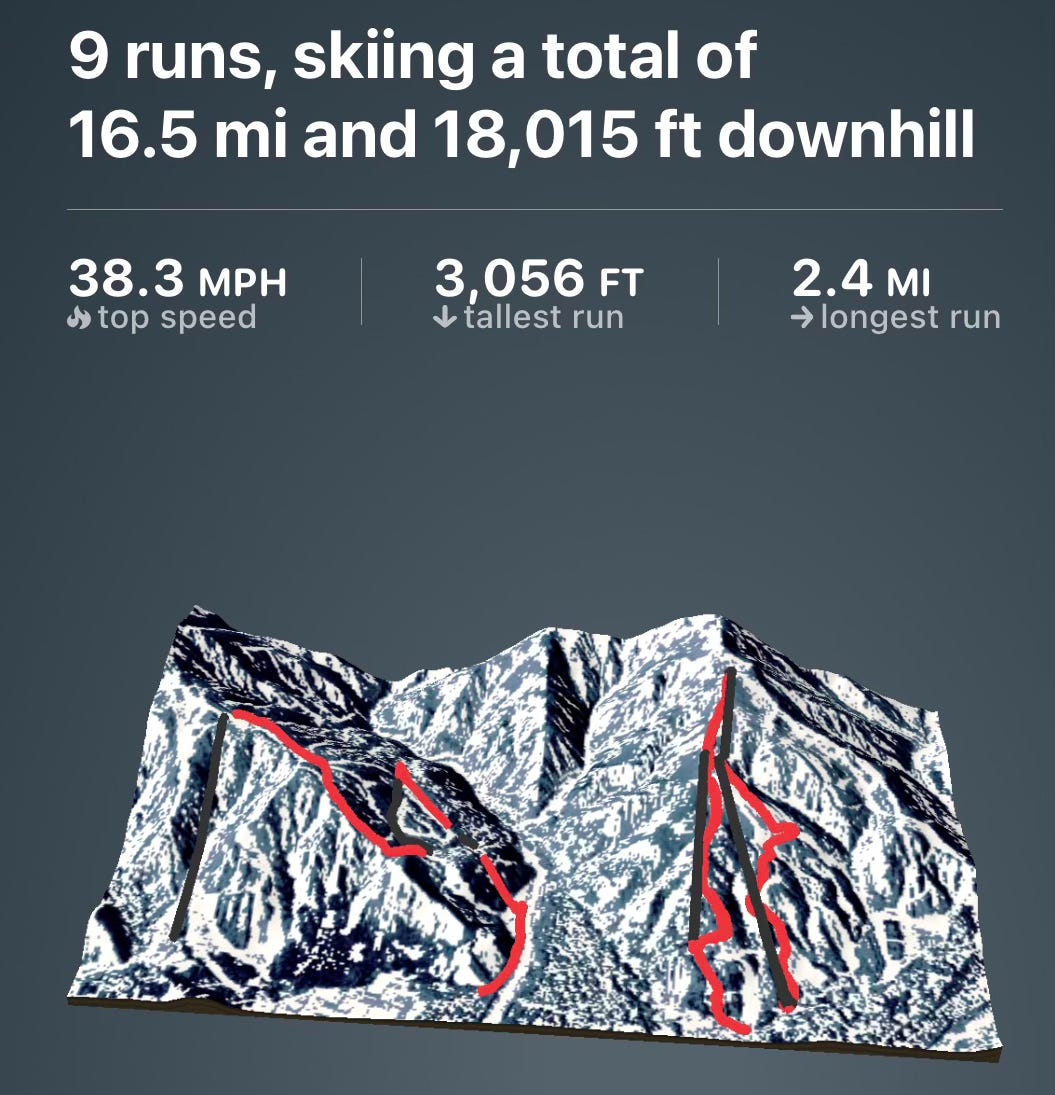
Where shit hit the fan was on Day 1 in Japan when I went skiing in Hakuba and, ate ice, and fractured my knee. That’s right, on Feb 18, I ate shit and got injured. Can you guess what was going through my mind?
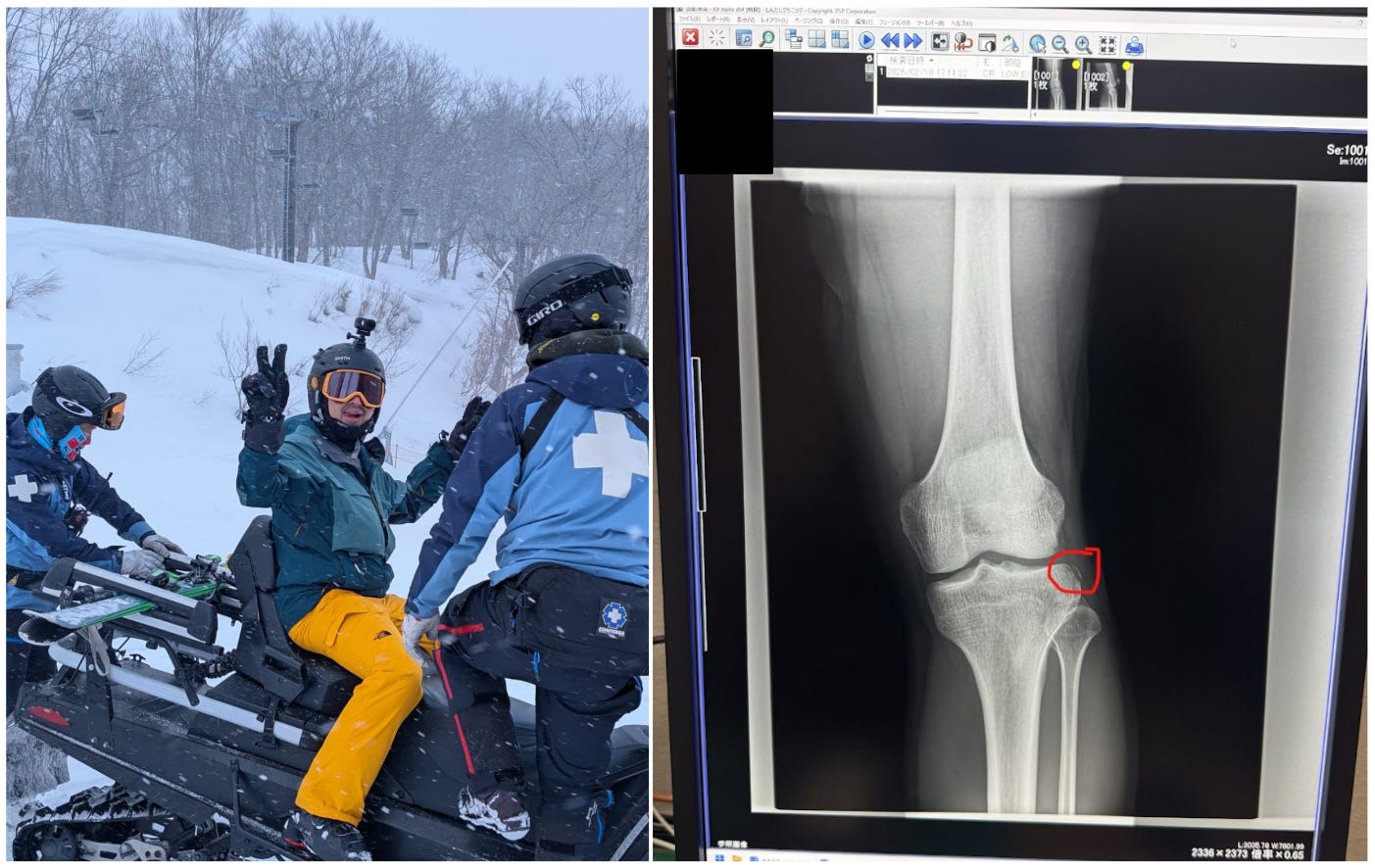
I have a video recording of the incident and it basically amounts to me saying “ow that hurt” and my ski’s not detaching as I rolled. My friends were there to help me get up (shoutout to J & K) and I with the help of snow patrol, I was brought down the mountain, uberred my way to a clinic, and from there I got an x-ray.
That simplifies that to more than what that was. What actually happened after eating shit is J helped me up, K assessed my knee and determined it wasn’t a full ACL tear, and then snow patrol came to take me to the Gondola. My friends sent the snowmobile photo above to the group chat that included my wife, and her first thought was “TFTI on snowmobiles” followed by “wait that’s my husband and that’s snowpatrol.”
When I arrived at the clinic, still in my skier gear, I had to take off my ski boots to enter. That is usually a trivial task, but in this case with a stiff knee that can’t flex, it was far from trivial. The clinic definitely saw a lot of japow chasers and their injuries, I adding to the expected casualty list.
The Japanese doctors did their best, and through language barriers they explained my left knee was currently very different from my right knee and demonstrated “just how different” it is by squeezing the muscles and showing the jello-ness of the left leg vs the stiffness of the right.
Doctor said I can’t ski or do anything, gave me the Japanese version of Motrin (a NSAID), a very robust leg brace, and told me to be off my feet for at least 7 days and to get an MRI immediately when I get home.
So that’s the end of my ski trip, day 1 of a 2 week trip.
I just want you to know, dear reader, my left knee:
Was going to swell a lot.
was incapable of bending passed 90 degrees
any lateral movement (left or right movement) is a NO go.
I think the worst part of this ordeal is after the doctor’s diagnosis, I still had to get back to my lodging and my only shoe I had to leave the clinic was ski boots that I had to take off when I was at the doctor. I am thankful my wife was with me for that, I could complain that the ski boots were harder to do than getting up from the original injury.
I would spend the next few days nursing my foot and keeping it elevated, and my left knee did swell to a very visible difference. I think from the point of accident, I spent 2 days with very minimal time on feet, perhaps only walking at most 15 minutes with a brace and medication. Time would pass and I’d binge watch movies such as the Aliens franchise and started Drops of God. Though we had a very fantastic lodging, my need to move was great so I would slowly and patiently, just kidding, I would just commit to walking for 30 minutes to 60 minutes at a pace slower than everyone, sometimes leaving ahead of the group.
About 5 days later I did my first 2 mile run at a 15 minute per mile pace in Nozawaonsen. I couldn’t go any faster, nor should I, but it was good to “Be on my legs moving”. I walked the inclines, as that was a very steep little town. This was more of an assessment for me, and it did give me confidence. The next day I did about 6 miles of walking in Nozawaonsen, and I also try skiing a very easy trail twice. By this point, I was T-Minus 4 days from Tokyo Marathon.
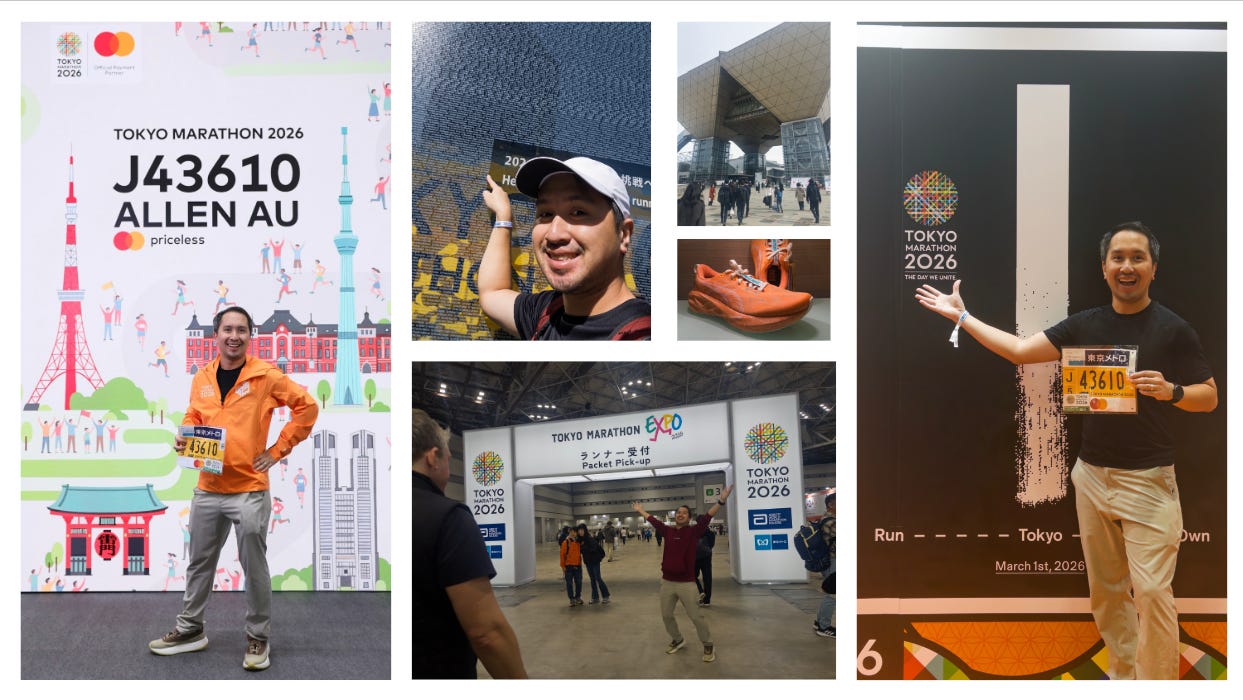
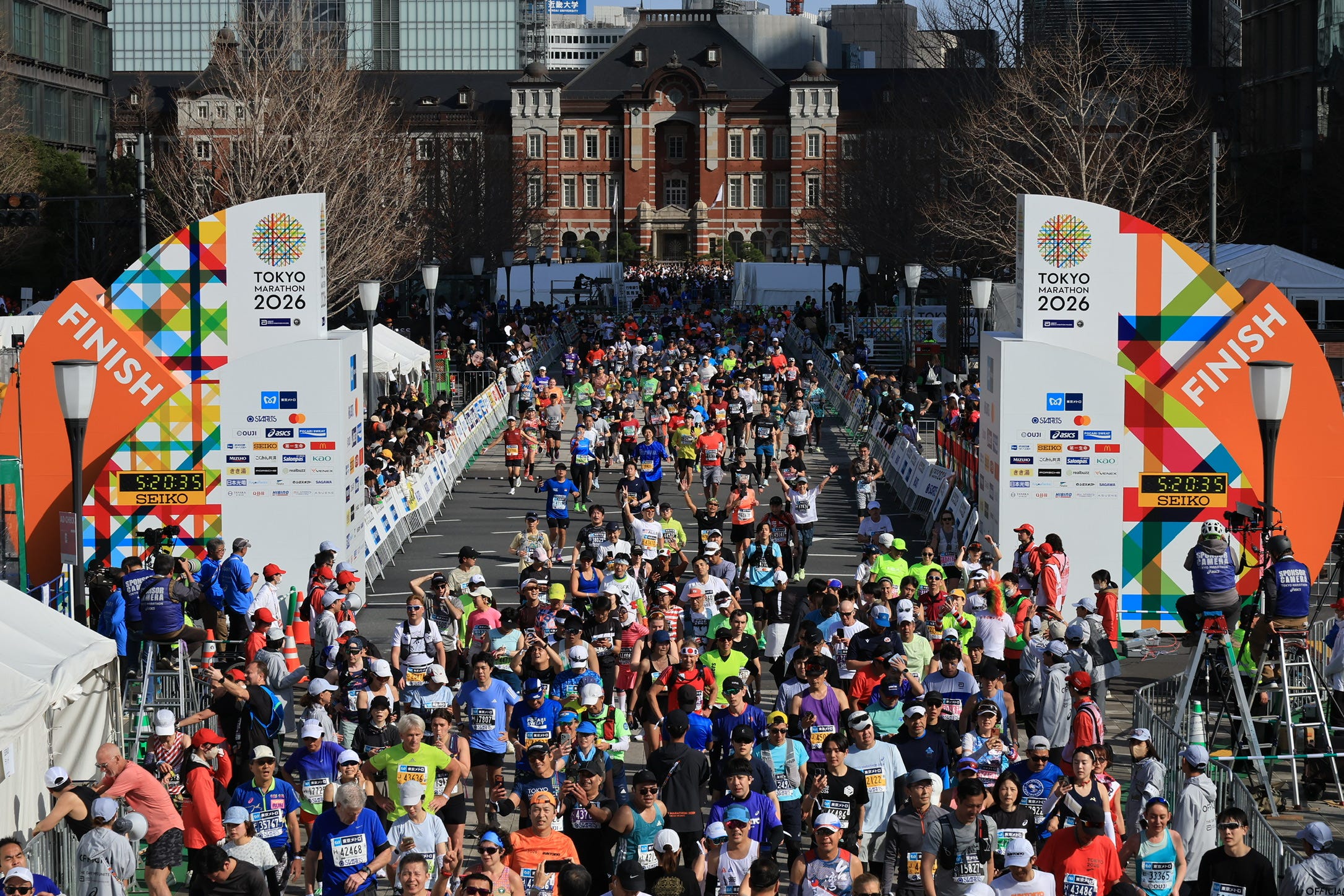
The Tokyo Marathon has three claim to fames:
It is infinitely the best organized marathon on the planet and it will ruin you.
it’s part of the Abbot Running World Majors
Almost all lottery based marathon - 39,000 runners selected across 300,000 applicants.
The hype and prestige surrounding it can, as my wife observed, drive those who get in into an obsession to fulfill it. There are Facebook groups where spouses of runners talk to other spouses of runners about how incredible it is and once in a life time the Tokyo Marathon is and that their runner can walk it for the 7 hours if injured.
My wife understood me on the day of my injury that I couldn’t really be stopped. I am lucky.
T-Minus 2
For those unfamiliar with running, believe it or not, when your legs are stiff, we have what is called a “recovery run” which just that - you run, at a very slow pace, to get blood circulating and improving restoration. I do these even after the hardest efforts.
We also have this thing called “shakeout runs”. In a perfect world, you “don’t run as much” the week of your race, and then you get your jitters out 1 to 2 days before the actual race. You don’t put any effort in the run, it’s merely there to get blood moving.
I stayed at the New Otani Hotel near Sophia University in Chiyoda which offered a nice garden route to run through which included a lake and waterfall. A perfect place for me to come to realize that my legs felt like they already ran 6 miles, before I even finished the first 100 meters. The end of this shake out run allowed me to confidently determine I was reduced capacity by 25% to 33%.
The Tokyo Marathon would not be a marathon to set a personal record. Instead, it would be a marathon where I set personal meaning.
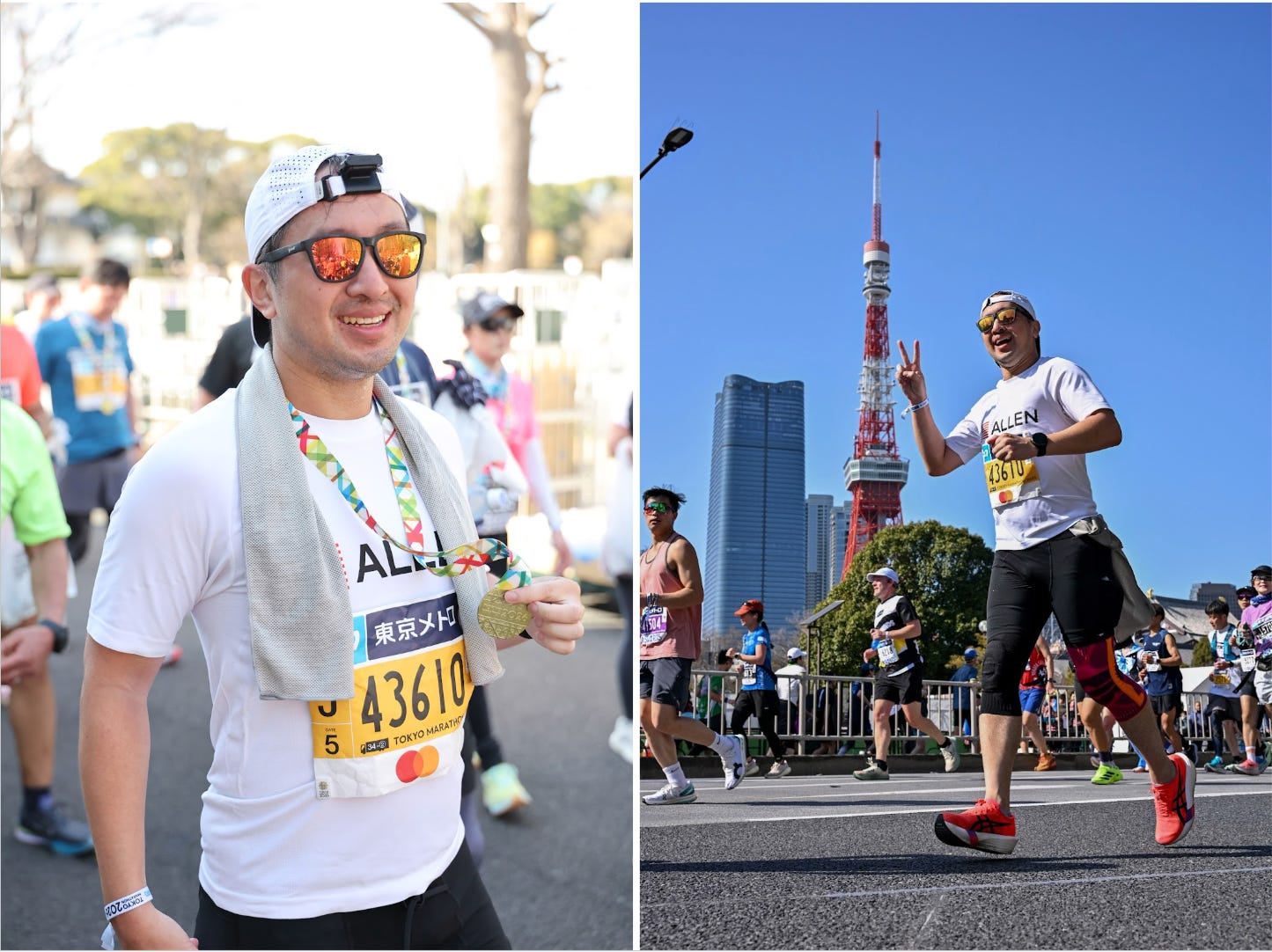
I’d do it again
I have never had as much fun running in my life as I did the Tokyo Marathon, and I could argue it was also the most traumatic experience on my body. Those who do run hear often via incessant feeds of all sorts of people who do sub 3 or sub 4 marathons or do many marathons a year. And as welcoming and encouraging as those are, it sometimes can trivialize just how difficult a marathon inherently is.
I mean the first guy who ran it between Athens & Marathon famously died.
I can tell you, dear reader, that this marathon, was the most enduring, rewarding, shit-eating grin, grueling, and gratifying experience of my life and during the run I experienced:
I have my name on my shirt, courtesy of Mastercard, which allowed quite literally everyone in the Tokyo Marathon to yell my name. 10/10 would recommend at all times, #1 gear accessory.
I’m wearing two knee braces (Bauerfeind, flagship store in Tokyo!), the one for my injured leg to keep it confident, and the other one so it wouldn’t feel like it was missing out on anything. This was a good idea - I didn’t want to alter form, and the braces really help my brain think “it’s going to be okay”.
peeing my shorts because the line to the restroom at mile 14 was too long
And I brought racing shoes that do not reward slower pace as they were brought assuming I was going to go under 4 hour (9 minutes per mile) but instead achieved a 11:20 per mile pace
There was a heatwave which picked up by noon especially on the east-side of the Tokyo Marathon (Kuto, Chuo, and Ginza). I think because of my slower pace, my face was directly staring at the sun for more than half and since we are in a city with asphalt, the streets were a lot hotter because of it. You know how many people were passed out on the sideline with medics on them? A lot!
Dehydration by hour 3 because it turns out NSAIDs prescribed to me to treat my knee injury severely restrict kidney, and does prevent me from processing water and electrolytes effectively, resulting in pee that was brown and sparse.
And above all else, seeing my friends and my wife across Tokyo and coordinating sightings of me.
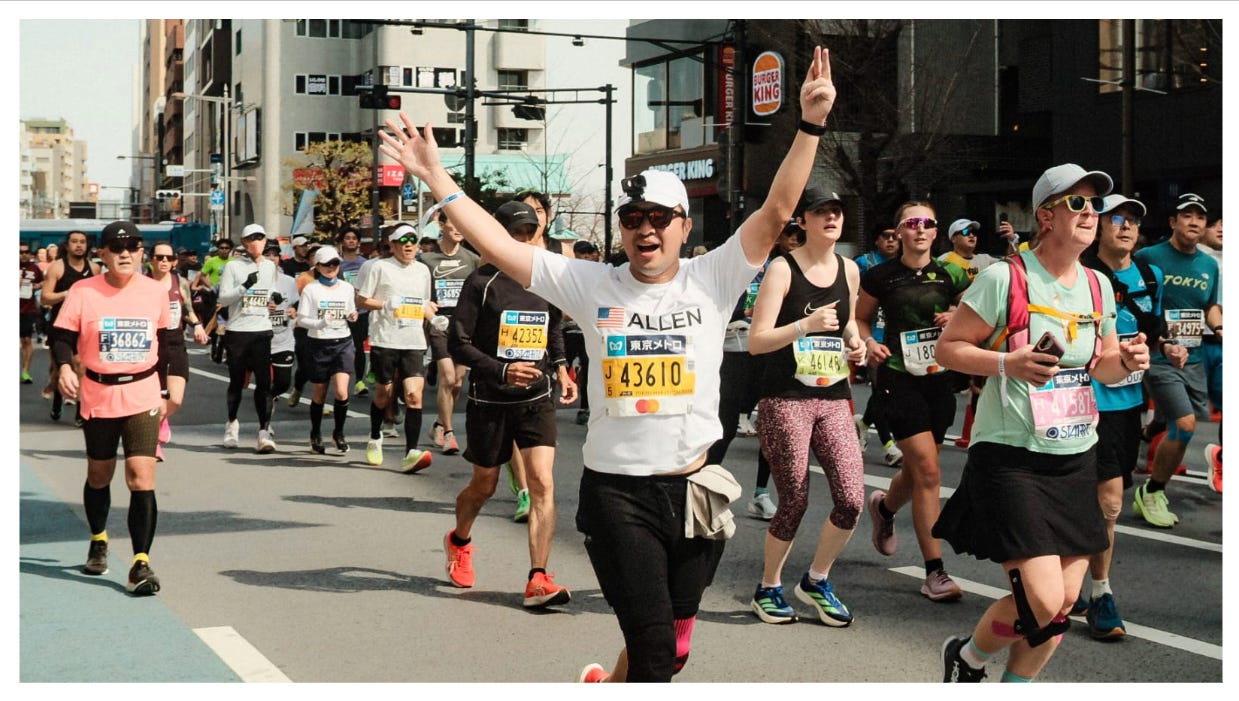
Triumph
This is single handled the best photo of me in the Tokyo Marathon. It’s not quite the half way mark, but it does represent the fact that “well I have nothing to do but to run forward”.
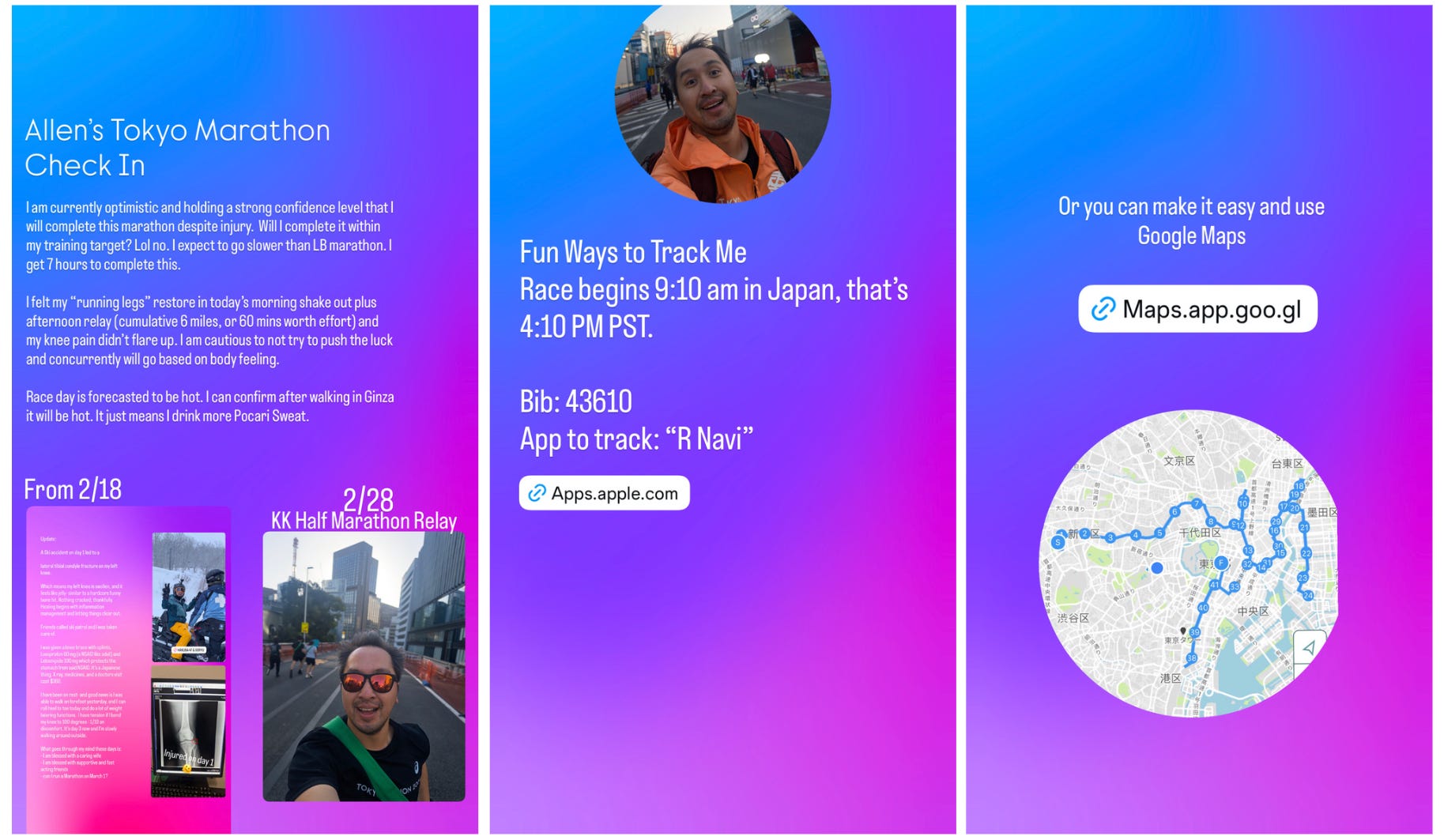
In Tokyo, spectators have the opportunity to take public transit and catch their runners a few times. That doesn’t mean it’s easy. My friends were trying to catch me across an entire town amongst 39,000 runners, and my tracker is on!
The photo above is taken by Asakusa, right as I pass the temple and turn the corner and was leaving the area.
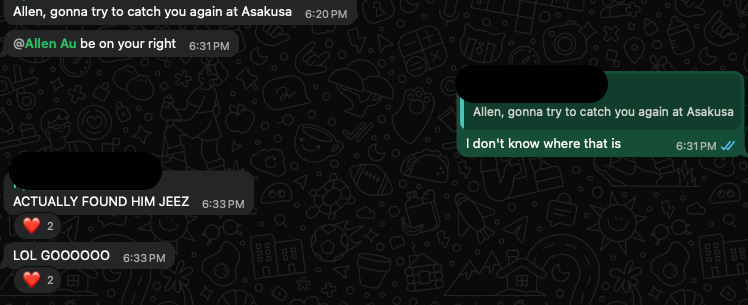
This is just a snippet of the group chat. It was a great highlight of the run. I wasn’t going to PR in speed, but I was going to remember the marathon fondly.
Perhaps thats the beauty about running. When done right, there is the next run. How you enjoy the run, is up to you, and for what reason you enjoy, is also up to you.
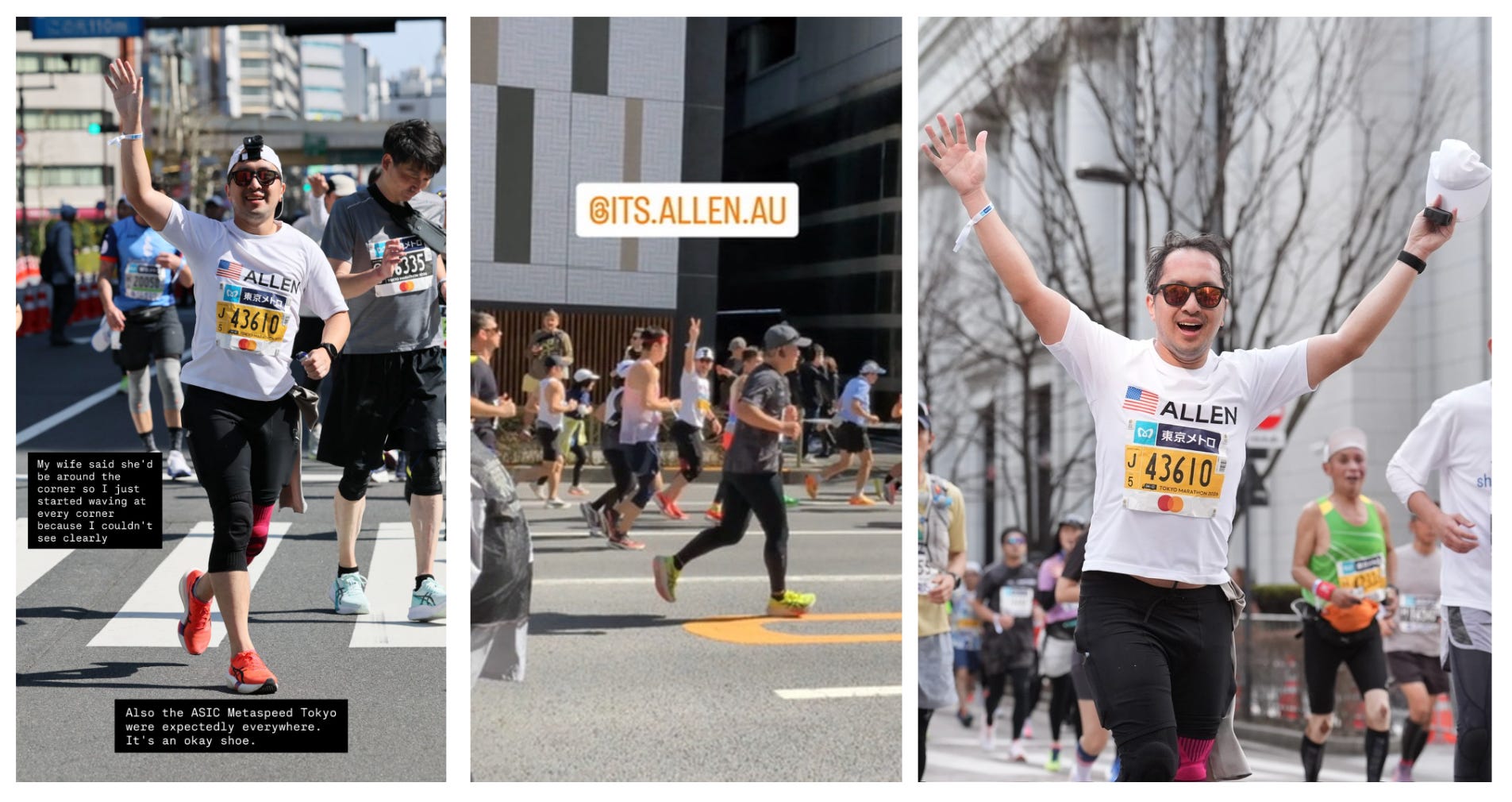
Race day journal
A memoir note written after I complete the marathon on a flight back home:
The First Half
My legs were tired before the gun went off.
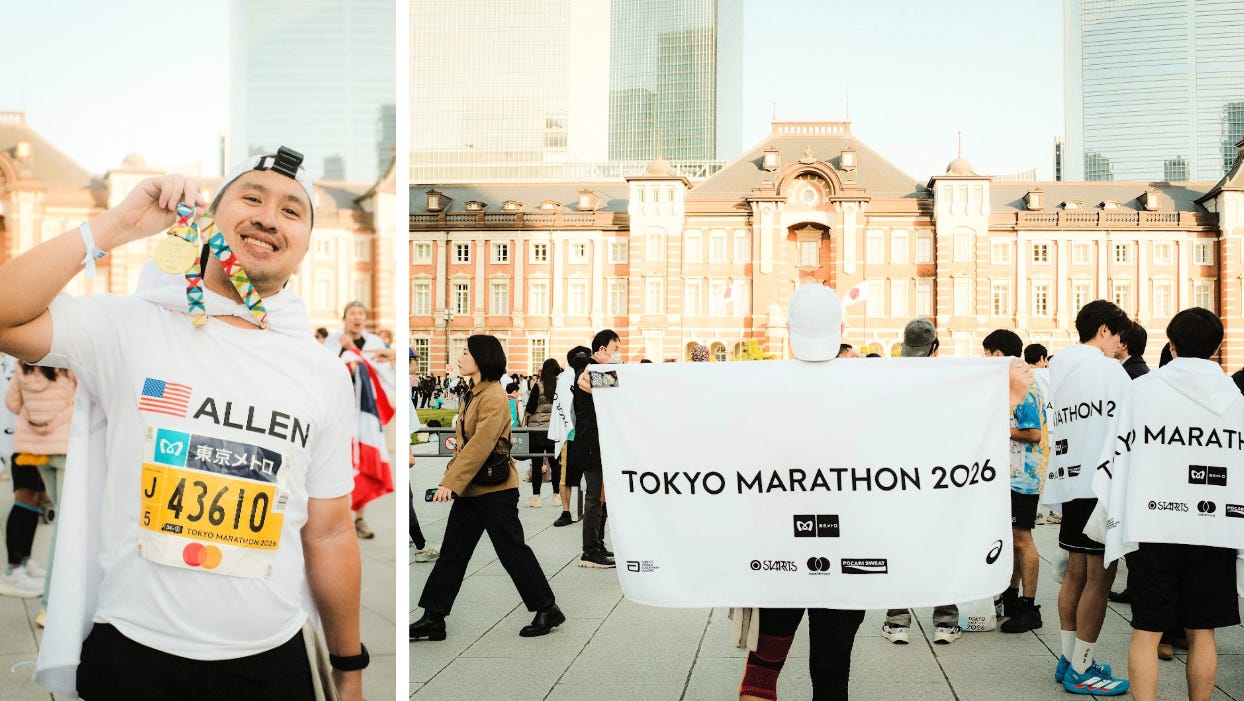
I’d gotten my racing t-shirt I got from Uniqlo with a name screen printed at the Mastercard booth at the expo. They only did flags + name, so I did ALLEN, big across the chest with an American flag. This is one of the least regrettable decisions I made all week, and I got a lot of vocal support for it. For the entire race, strangers cheered for me by name. A guy holding a French flag. A group of elderly Japanese women who pointed at me and said my name. A group in Mexican shirts who went absolutely wild when I shouted back “¡Gracias!”
My friends, meanwhile, were running their own parallel ops. There was a WhatsApp group going the entire race. They’d coordinate positions, I’d read their messages mid-run trying to figure out where they might be.
“You’ll see us at mile 7.”
Left side or right?
Left. I passed.
They missed me.
“We’ll get you at mile 12.”
Missed again.
Then I realized: the course is in kilometers. The map is in kilometers. They were thinking in miles. I typed back: “you mean KM, LOL.” Shortly after kilometer 12, R and J shouted my name (middle phot oabove) loud enough to cut across the entire race track. In hindsight, I wish I stopped to say hi and take a photo with them. Why not? It’s my marathon.
At kilometer 22, near a shrine in Asakusa, R found me almost entirely by chance. We’d missed each other twice, and as the photos show, I have the biggest grin.
The Second Half
Here’s something I didn’t know going in: the anti-inflammatory medication I’d been taking for the knee injury was an NSAID. NSAIDs compound dehydration during prolonged effort. I found this out the hard way.
By the later kilometers I was managing a knee injury and dehydration simultaneously. At one point I lost control of my bladder, just after the half way pint. That’s just the reality I had to contend with while running a marathon on a injured knee body. At least I had a copious amount of Wagyu.
I kept going, and would toss water at the aid stations on my shorts to help wash it off. I’d take bites, and observe various runners on the floor being attended for their heat-related injuries.
I’d read signs, well, try to read signs, and wave at random corners expecting my wife to be there. It was easier to do that than to squint then wave, because then people would get photos of me squinting.
At kilometer 42, just before the end, my wife found me. She’d been navigating Tokyo all day trying to track a husband moving unpredictably through a city of millions. She missed me more than a few times. But she found me right at the end, and I mean like .2 miles away from the end.
I crossed the finish line, happy, relieved, stressed, and most of all, accomplished. I think the biggest surprise was walking out of the finish line only to be handed a bag with “sponsors expected to fill it up”, and fill it up they did.
You know what I got out of it all?
An ACL Injury!
Specifically a Segond fracture on my left proximal tibia resulting in bone marrow edema. This basically means a small piece of bone fractured off where it should be and is being held to the main bone by bone edema, and it would take a few months for it to harden (like cartilage).
So since I race the marathon, all I’ve done is nurse the foot by not putting impact on it, doing my strength exercises, and becoming maddened by elliptical machines.
Thanks for reading. Come back next week where I talk about the final installment of this running reflection. You can tell your friends you know a lunatic.